PDF Download Salvation to the Ends of the Earth: A Biblical Theology of Mission (New Studies in Biblical Theology No. 11)
Exactly what do you believe to conquer your problem needed currently? Reviewing a publication? Yes, we agree with you. Publication is just one of the actual sources and also enjoyment resources that will be constantly discovered. Numerous publication shops also provide and offer the collections books. Yet the shops that sell the books from other nations are uncommon. Thus, we are below in order to help you. We have the book soft data links not only from the nation but additionally from outdoors.
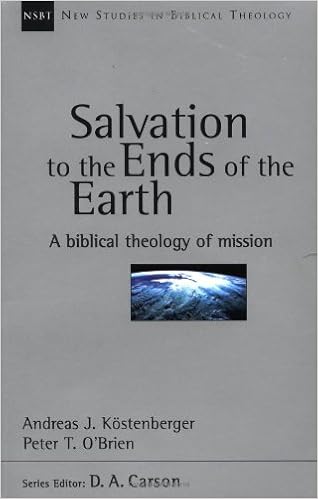
Salvation to the Ends of the Earth: A Biblical Theology of Mission (New Studies in Biblical Theology No. 11)

PDF Download Salvation to the Ends of the Earth: A Biblical Theology of Mission (New Studies in Biblical Theology No. 11)
Still need new ideas to cover and address your troubles? Is your trouble related to business, work deadline, life, institutions, or others? Certainly all individuals will are such problems that could lead them constantly make wonderful initiatives. To help you, we will share a god book to check out. Possibly it will help you to address certain issue that you face now. That is the soft documents of Salvation To The Ends Of The Earth: A Biblical Theology Of Mission (New Studies In Biblical Theology No. 11) as recommended publication in this website today.
Besides, the book is recommended due to the fact that it gives you not only home entertainment. You can transform the fun things to be great lesson. Yeah, the writer is actually wise to convey the lessons and material of Salvation To The Ends Of The Earth: A Biblical Theology Of Mission (New Studies In Biblical Theology No. 11) that could attract all viewers to admire of that book. The writer likewise gives the basic means for you to obtain the fun entertainment. Check out every word that is utilized by the writer, they are actually interesting and also simple to be constantly recognized.
This book supplies not kind of typical book. It will offer you the very easy by to check out. So, it will certainly not buy you to seem like studying the books for the exam tomorrow. This is why we call as the detailed reading. You could have only check out Salvation To The Ends Of The Earth: A Biblical Theology Of Mission (New Studies In Biblical Theology No. 11) in the spare time when you are being someplace. This book will certainly also not only offer you the inspirations, some words to include will certainly give you little however enjoyment. It is exactly what makes this publication ends up being preferred one to read by many people in this globe.
When you are assuming that this publication is likewise appropriate for you, you have to set the moment when you wish to begin reading. In making the concept of the reading book, this publication can be starter point to lead you enjoying a publication, not only to display yet also to check out. Currently, try to comprehend it as well as allow your loved ones understand about this book as well as website. You could educate to them that this site truly gives billion titles of publications to check out. So, accumulate and obtain the functions.
Few biblical topics are as important as mission. Mission is linked inextricably to humanity's sinfulness and need for redemption, and to God's provision of salvation in the person and work of Jesus Christ. This "good news" of salvation must be made known! The saving mission of Jesus constitutes the foundation for Christian mission, and the Christian gospel is its message. According to Andreas Köstenberger and Peter O'Brien, this significant theme has rarely been given its due attention in biblical theology. Motivated by their passion to see God's mission carried out in today's world, they offer a comprehensive study of the theme of mission. In Salvation to the Ends of the Earth they explore the entire sweep of biblical history, including the Old Testament, the second-temple period, each New Testament Gospel, Paul and his writings, and the General Epistles and Revelation. Among other questions, Köstenberger and O'Brien examine whether or not Old Testament Israel was called to mission, whether second-temple Judaism should be characterized as a missionary religion, whether Jesus limited his earthly mission to Israel or also embarked on a Gentile mission, and whether or not there is continuity between the missions of Israel and the missions of Jesus and the early church. They write, "It is our sincere hope that our Christian mission, which is first of all God's, will be founded on a biblical theology that takes its cue from the scriptural revelation as a whole." To that end, they offer this New Studies in Biblical Theology volume as a service to the worldwide church. Addressing key issues in biblical theology, the works comprising New Studies in Biblical Theology are creative attempts to help Christians better understand their Bibles. The NSBT series is edited by D. A. Carson, aiming to simultaneously instruct and to edify, to interact with current scholarship and to point the way ahead.
Your recently viewed items and featured recommendations
›
View or edit your browsing history
After viewing product detail pages, look here to find an easy way to navigate back to pages you are interested in.
Product details
Paperback: 351 pages
Publisher: Apollos / Inter-Varsity Press (March 20, 2001)
Language: English
ISBN-10: 0830826114
ISBN-13: 978-0830826117
Product Dimensions:
5.5 x 1 x 8.5 inches
Shipping Weight: 1 pounds
Average Customer Review:
4.2 out of 5 stars
8 customer reviews
Amazon Best Sellers Rank:
#290,534 in Books (See Top 100 in Books)
A primary thing to note about Kostenberger and O'Brien's presentation is their integration of history, literature and theology to draw some very pointed theological borders. From a historical perspective, they survey some of the Old Testamental period, a brief portion of the era of the second temple and a large section of the New Testamental period. From a literary standpoint, they place an emphasis on the role of Israel as a mission tool and yet exalt the role of the Christian church as missionary. With a theological vantage, they also put a heavy emphasis on redemption. Where Kostenberger and O'Brien excel though is how they clearly outline the bounds for such a study on exegetical grounds. A more indepth review is available at buckburch(dot)blogspot(dot)com
First and foremost, the most positive side to Köstenberger and O'Brien's book is the section which focuses on the biblical books of Luke and Acts. Oftentimes theologians look at the man of missions - the Apostle Paul - as their number one example. They look at his work, who he was, what he did, how he related to the cultures, and of course what his mission to the Gentiles was, in order to come up with their definitions of mission. In Salvation to the Ends of the Earth, I thoroughly enjoyed the time spent looking at the writer of both Christ's and Paul's missions - the Apostle Luke. This section on the Lukan writings does a great job describing God's mission through the coming of Jesus Christ, and how that was applied to the church's mission (namely through the historical records of the New Testament Church found throughout the book of Acts). Köstenberger and O'Brien also key in on the important passages that played a role in the transition of the mission of God in the Old Testament to that of the New. Looking at Lukan books this way lays out a historical time-line for the reader to see what took place during Christ's incarnational ministry here on earth, and how it brought about the mission that would then be done by the church.Another point of great importance is found in the authors' dealing with the book of Acts, specifically, looking at how the mission of the gospel was spread among Jerusalem, Judea, and Samaria. In this, Köstenberger and O'Brien concentrate on how Luke focused on the promises that were given to Abraham, and how this then ran throughout Luke's writings (p. 137-8). This is then broken down further in the sermons of Peter, Stephen, and Paul, throughout the key passages which they highlight.What is most important overall in this section is the understanding that the Gospel of Luke cannot be read without Acts, and likewise, that Acts cannot be read without the Gospel of Luke; they go hand-in-hand if you are looking for a proper biblical theology of mission (p. 111-2). For example: the writers do a great job of explaining that you cannot properly understand Jesus Christ's command in Acts 1:8 without first reading Luke's account of Christ's mission (p. 111). Furthermore, understanding that the early church's mission is found in what Christ did Himself during His earthly mission (that is, what He did in order to give the Spirit), Luke's books - both his Gospel and the book of Acts - must be seen as a historical record of the mission of Christ, and the giving of the mission to the New Testament church. In all, Köstenberger and O'Brien seem to see that the book of Acts and the Gospel of Luke are the most helpful and clearest perspectives of the mission of God during Christ's time, and also for that of the New Testament church today.Another positive side of this title is the section on John. It seems that over the past 10 years both the Gospel of John, and John himself, have gotten much flack for "not being missional." Köstenberger and O'Brien hit right at that point - that John is missional in his Gospel. They seem to understand that this mistake of viewing John as non-missional is mostly because of Matthew's Great Commission, and Luke's Gospel, which is then followed by the historical value that Acts brings to the theology of mission. Köstenberger and O'Brien see the importance in what John is writing, and also see John's focus on Jesus' mission here on earth. In this section, instead of dealing with certain passages the way they did in their previous chapters, the authors lay out the events and topics of Christ's earthly work, and how they relate with mission. In doing so, they focus on Christ's humanity while on earth, and how He played out the mission of His Father in the bringing about what was to come. They do this by focusing on the truth that the gospel's primary interest lies in Christ's relationship with His Father, and not the ontological nature (p.204).After dealing with this, the focus is then turned from Christ's mission to the community of His disciples, to the disciples then going out and living what Christ gave them for their communities (p. 204-22). A key point in this section is found as the authors point out that the Gospel of John never once focuses on the disciples' work, signs, etc., in the way the other Gospels do. Instead, John focuses on Christ's mission - both His own earthly mission (John 1-13) and the giving of His mission (John 14-21).NegativelyLike most biblical theologies I come across, this book seems to have purposely (or unknowingly) neglected the Old Testament. Time and time again biblical scholars spend countless words in their writings dealing with the New Testament, and do not spend enough time dealing with the Old Testament. Here, Köstenberger and O'Brien have spent barely 50 pages looking at the Old Testament's theology of what mission is, and well over 200 on the New Testament's theology of mission. Why is this happening so commonly? Is there a lack of mission in the Old Testament? Or is it the lack of dealing with the whole canon equally? It most certainly is not the lack of God's mission in the Old Testament. For example: if one is looking for a proper understanding of a biblical theology of Mission in the Old Testament, Christopher Wright spends more than 75% of his massive 581-page book The Mission of God looking at the Old Testament.Another negative aspect of Köstenberger and O'Brien's title is that they say that Jonah is not a missionary (p.44-5) - something I personally do not agree with. They believe that saying Jonah was a missionary is "going too far." To me, I feel as though the prophets were, in some way, missionaries to Israel and even to other nations from time to time. Regardless, the authors spent barely one page defending their argument that Jonah is not a missionary, and were therefore quite lacking to convince me of their view.Lastly, Köstenberger and O'Brien seem to be in disagreement with many Missiologists as they do not believe that the second-temple period of Judaism was missional (p.55-71), nor had a mission at all. I completely disagree with this. I personally felt that their statement, "while the Christian canon itself provides little (if any) information regarding mission in the second-temple period" (p.55) is absurd. Were there not still thousands of synagogues carrying out the same purpose, and countless priests carrying out the same mission they were called to? Furthermore, why in Acts 2 did Peter have to defend the new mission of Pentecost against that of the Old mission, which the Jews were still trying to carry out? I could be wrong, but it seems that this distinction they make is largely due to their separation in eschatology - that is, the Old Testament and New Testament having separate eschatology (p.232-250). I say this based on how they conclude their ending sections on "The Second-temple Period" and how they conclude Revelation as well. It seems that they see the second-temple period as the ending times for Israel; and also see that both the nation of Israel and the New Testament church have separate ends in their missions. In this, they then separate eschatology. How this affects their Old Testament interpretation is that it then creates first-temple mission and second-temple eschatology, which I personally do not see as clear as they try to make it.Another flaw in thinking that second-temple Judaism was not missional is that it hints that the mission that was given by God was not carried out. God's mission that started in Genesis 3:9 and Genesis 3:15 was still existing, and yet saying second-temple Judaism was not missional argues whether or not God's covenant people were still in His mission (Genesis 10). Were not the Lord's people still waiting for their Kingdom (Psalm 72)? Was not Israel looking for their expansion and shalom (Isaiah 45:22)? Just because they did not keep their covenant with the Lord did not mean that the Lord (and some of the Lord's chosen nation) did not continue to keep covenant. On this subject, I'd personally rather spend the time reading Walter Kasier's Mission in the Old Testament: Israel as a Light to the Nations.
The topics in this book even at a glance will show u that the authors have a good grasp of the subject of missions as that which is central to the fulfilment of all mankind entering into God's rest via the redemptive work of Christ. It helps answer the question " is salvation to the gentiles a secondary thought of God or always has been a part of God's redemptive work even in the OT. It is systematic theology at its best and helps to affirm the new covenant as the covenant of all covenants. Written to the glory of the God, showing indeed that he is no respector of persons, and saves all kinds of men throughout the world so that not men from every part of the earth, together with the redeemed physical descendents of Abraham may share in the glory of his inheritance given in a seed form to Adam in the garden, to Abraham in the promise of the land, to Isreal and then consummated in the new heavens and earth (New Covenant).
This is one required text in a course I am taking in a graduate seminary course on Global Missions. Kostenberger and O'Brien move through the complete Bible text showing the historical intent of God for complete world proclamation in response to the promise to Abraham that through his seed that all nations would be blessed.
This was a well articulated book, but I'm not so sure I can agree with the author's conclusion. A "center" theology tends to be an overly simplistic way at looking at the Bible.
Salvation to the Ends of the Earth: A Biblical Theology of Mission (New Studies in Biblical Theology No. 11) PDF
Salvation to the Ends of the Earth: A Biblical Theology of Mission (New Studies in Biblical Theology No. 11) EPub
Salvation to the Ends of the Earth: A Biblical Theology of Mission (New Studies in Biblical Theology No. 11) Doc
Salvation to the Ends of the Earth: A Biblical Theology of Mission (New Studies in Biblical Theology No. 11) iBooks
Salvation to the Ends of the Earth: A Biblical Theology of Mission (New Studies in Biblical Theology No. 11) rtf
Salvation to the Ends of the Earth: A Biblical Theology of Mission (New Studies in Biblical Theology No. 11) Mobipocket
Salvation to the Ends of the Earth: A Biblical Theology of Mission (New Studies in Biblical Theology No. 11) Kindle